PROGRAM NOTES
Academic Festival Overture | Johannes Brahms (1879)
By the late 1870s Brahms’ position as a preëminent composer was well recognized. He was almost universally admired for his first two symphonies, his two serenades, and the “Haydn” variations. So, in 1879 the University of Breslau in Prussia (now Wrocław, Poland), in the best tradition of universities everywhere, brought honor to the distinguished composer—and distinction to itself, of course—by awarding him an honorary doctorate. Typically, Brahms modestly sent a letter of thanks to the university, and called it a day. But, he was urged to respond in a more substantial fashion, and so composed his Academic Festival Overture, one of his only two works in that genre. The title in English is a bit misleading, for there was no actual “academic festival.” It’s only a poor translation from the German—the reality being an “overture in festive style.” Brahms, while a genial and warm man, rarely let down his dignity—and let’s face it—is not known for his fondness for humor in music. His popular image of a portly man with a generous beard, an omnipresence cigar, and a serious mien is not without some truth. But in this instance, Brahms responded with one of his happier and more accessible compositions. Rather than a concert overture worked out with original themes, perhaps in the manner of, say, a first movement of one of his imposing symphonies, he chose to surprise everyone with a lighthearted mélange of traditional student drinking songs.
While most of the tunes are unknown to contemporary American audiences, the swirling, magisterial last section is based upon the universally familiar Gaudeamus igitur (a cliché in the soundtrack of every Hollywood movie set on a college campus in the 30s and 40s.) Some folks today may also recognize bits of the famous Rákóczi March (familiar these days from Berlioz’ Damnation of Faust). But to their delight, the German university audience at the time would have recognized all the songs that Brahms quoted or alluded to. But, Brahms, being Brahms, would never have countenanced a simple medley of tunes hooked together willy-nilly. Rather, the form is as tight, clear, and developmental as you could ask of this skilled structuralist of musical logic. It takes a master to serve up something ostensibly light, but which takes its place among the most revered of concert masterpieces. It may be somewhat of a medley, but it all sounds irrepressibly Brahms.
Written by William E. Runyan.
Piano Concerto in A minor, op. 54 | Robert Schumann (1841-1845)
This work was Schumann’s first piano concerto, the best of the lot, and deservedly one of the most popular in all of the repertoire. Schumann composed in almost all of the common genres, and notwithstanding his success in the larger forms, did perhaps his most respected work in song and piano literature. A gifted and passionate musician, he was privileged to be married to the love of his life, Clara Wieck, herself a respected composer and highly regarded concert pianist. Known—at least during his lifetime—almost as much for his distinguished career as music critic and essayist, even today his analyses and commentaries lend valuable insights into the music of his milieu and times. He was a formidable pianist—his wife even more so—and his contributions to the piano stand with those of Schubert, Chopin, and Brahms in artistic significance.
Schumann was a Romantic to the core, as evidenced by the deep emotional feeling imbued in his works; by his great appreciation for fine poetry in his song settings; and by his ability to create unique and profound art in the briefest of music moments. Yet, withal, he had great respect for clarity, balance, and formal integrity so characteristic of the music of Classicism. It must be admitted, however, that to some degree his deep passions and emotional self-indulgences can be seen as aspects of a personality that ultimately broke down in the psychoses and pathologies that led to his early death in an institution. He was happy early on, however, and the years of his early marriage to Clara brought forth masterworks in spates, as his mind focused extraordinarily in narrow directions. He wrote primarily piano music during the 1830s, over 125 songs in 1840 (he called it his “year of song”), symphonic music in 1841, chamber music in 1842, and so on.
The A minor piano concerto stems originally from the year of symphonic music, 1841, and originally took the form of a single movement for piano and orchestra, which he entitled a Phantasie. It almost resembles a miniature concerto in one movement, for each of its three main sections—unlike the norm typical of usual first-movement form–has its own character and tempo. Moreover, he crafts most of the movement from essentially one idea (some say a kind of musical anagram of a pet nickname for Clara). In the middle section he recasts the opening theme into the major mode, in a kind of nocturnal mood. The last section takes its course in yet a new mood, but with reference to the opening theme. After the première of the work in that form in the same year he sought unsuccessfully for a publisher. Failing to find one, he put it away, but returned to the composition almost four years later, while recovering in Dresden from severe depression, exhaustion, and a variety of phobias. Deciding to remake the Phantasie into a regular piano concerto with the usual three movements, he added to it a slow movement and a finale in 1845. In that form it was published the next year, and as they say, the rest is history.
The work, notwithstanding the composer’s pianist abilities, reflects his deep suspicions of empty virtuoso bombast so often characteristic of contemporary piano works. While a document of true romantic feeling and expression, and certainly not without its moments of formidable technical challenges, it is a work of romantic taste of the highest order. Some elements of the first movement have been mentioned, and further notice should be given of the delightful and solicitous writing for solo woodwinds that engage the piano soloist. The Intermezzo of the second movement gracefully explores a variety of reflective moods and moves without pause into the buoyant finale. This last movement treats the theme of the first movement in the major mode, varying it constantly—both procedures common to the romantic period. Yet, in its midst the orchestra take a shot at fugue-like passage—definitely a relic of the distant past of J.S. Bach. But we must remember that at the time of the composition of this movement the composer and Clara had just finished a series of preludes and fugues in that old Baroque style. The dance-like theme hurdles along merrily, alternating with excursions to contrasting materials, before ending jubilantly. We’re more than fortunate that the early indifference to this ingratiating work led Schumann to flesh it out in such an endearing fashion, and it reminds us of the happier moments in truly gifted artist’s bittersweet life.
Written by William E. Runyan.
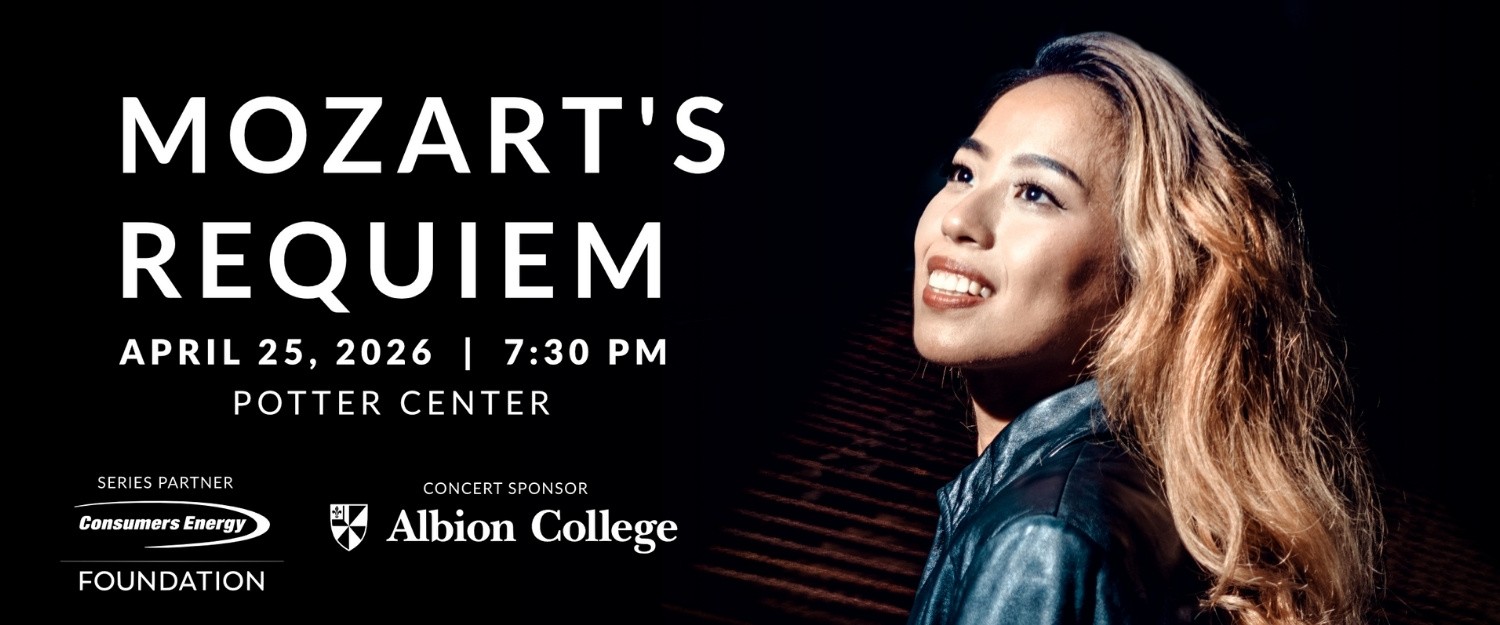
Requiem | Wolfgang Amadeus Mozart (1791)
Mozart’s Requiem stands as one of the most famous and deeply moving works in all of classical music. Composed during the final months of his life in 1791, it has long been surrounded by mystery and legend. The work was commissioned anonymously by Count Franz von Walsegg, who intended to present the composition as his own in memory of his late wife. Mozart, already in fragile health, accepted the commission and began work with great urgency.
As his illness worsened, Mozart became convinced that he was writing a mass for his own funeral. Though this belief was likely exaggerated in later retellings, there is no doubt that he worked intensely on the piece until his death on December 5, 1791, leaving the score unfinished. At the time of his passing, the opening movements were largely complete, while later sections existed only in sketches or vocal lines with figured bass.
Mozart’s widow, Constanze, determined to have the work completed so that the commission could be fulfilled and payment secured, enlisted several of Mozart’s students to finish the score. The final completion was undertaken by Franz Xaver Süssmayr, who orchestrated the remaining movements and composed portions of the final sections based on Mozart’s themes and instructions. The version heard today is largely Süssmayr’s completion, and it has remained the standard performing edition for more than two centuries.
Musically, the Requiem moves between moments of quiet reflection and powerful intensity. From the dramatic energy of the Dies irae to the gentle sorrow of the Lacrimosa, the music expresses feelings of fear, sadness, hope, and comfort. Its memorable melodies and emotional depth have helped make the Requiem one of Mozart’s most beloved and frequently performed works.
PROGRAM SCHEDULE
Johannes Brahms (arr. Leidig)
Academic Festival Overture <1879>
Robert Schumann
Concerto, Piano, op.54, A minor <1841–1845>
INTERMISSION
Wolfgang Amadeus Mozart
Requiem, K.626 (Süssmayr) <1791>
| RUNTIME: 2H |